
Ernest Albert Hills
WWI: Private, 9212 | WWII: Acting Flight Lieutenant, C6574
Ernest Albert Hills was born on March 29, 1892, in London, England. One of twelve children, he grew up in Whitechapel under extremely difficult circumstances. Despite a harsh childhood, Ernest showed remarkable resilience. At age 19, he emigrated to Canada with just $10 in his pocket and began building a new life, working as a clerk with the Dominion Express Company. They provided shipping services and express money orders which was a safe method of sending funds to distant places before credit cards and internet banking.
Two months after the outbreak of the First World War he enlisted at Valcartier, on September 22, 1914. He’d been an active member of the militia for a year and a half previously with the Queen’s Own Rifles and was assigned with them to the 3rd Battalion. He shipped out to England on the S.S.Tunisian on October 4, 1914.
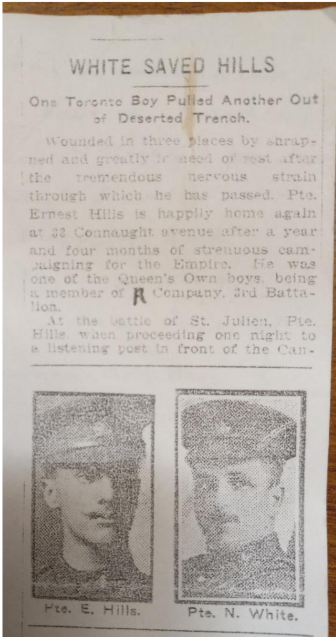
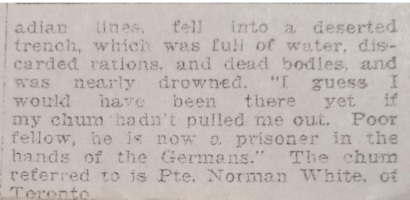
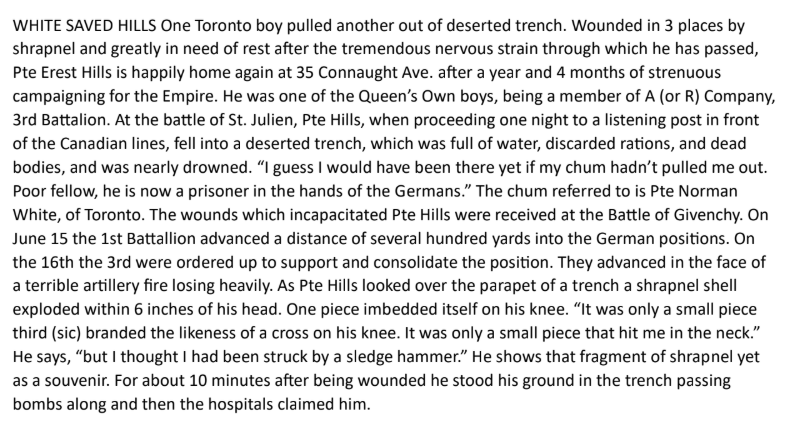
While serving with the 3rd Battalion he was active at the Battle of St. Julien and the Battle of Givenchy in Belgium near Ypres. This was at the time that the Germans first employed chlorine gas as a weapon. During the first battle in April 1915, he was out at night on a reconnaissance mission when he fell into a water-filled deserted trench and would have drowned if not pulled out by a fellow soldier, Pte. Norman White, a fellow Torontonian. (Details are in the newspaper clip below.)
At the second battle near Givenchy, the 3rd Battalion was advancing in support of the 1st Battalion. On June 16, 1915, Pte. Hills had slipped into a trench, then a shell exploded very close by. Shrapnel from the shell struck him in the head and neck, and a second piece in his knee. “It was only a small piece third (sic) branded the likeness of a cross on his knee. It was only a small piece that hit me in the neck, but I thought I had been struck by a sledgehammer.” He continued in his role, passing bombs along to the front for 10 minutes until he was taken away for medical treatment. (His account of the injury is also shown below.)
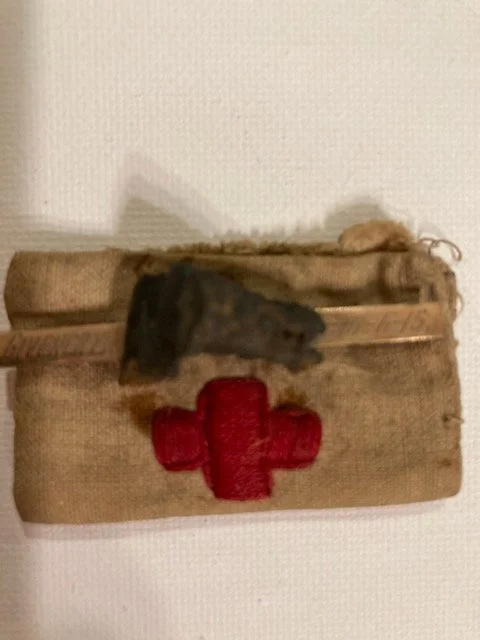
He was taken to the 1st Canadian Field Ambulance, then on to #10 Casualty Clearing Station and then transferred to 13th General Hospital in Boulogne for surgery to remove the shrapnel. This hospital treated casualties with injuries to the eye, jaw, and face. He was able to keep that piece of shrapnel as a souvenir! (The bar along the pin shows “Givenchy 16/6/15”, the date it lodged in his head. See photo below.)
He had a second surgery to remove cartilage from his injured knee. He remained there for two months then was moved for more convalescence by the Red Cross in Dublin, eventually stationed at the Canadian Convalescent Hospital in Epsom, England, that September. Unable to resume active service due to the extent of his injuries, he returned to Canada and was discharged. He was awarded the British War Medal and 1914-15 Star.
After being discharged Ernest was employed by the Consumers Gas company, and was Secretary of the Canadian Gas Association and Editor of the Intercolonial Gas Journal of Canada. He also drew up plans and built several homes in Scarborough. In 1922 he was approached by Canada Life to take over managing the Barrie Gas Co. until 1928 when he became the Assistant Building Superintendent of Canada Life’s Head Office. He also served as the Secretary-Treasurer of the local school section, and a platoon sergeant in the Scarborough Civil Guard. He also had one of the first cottages on Sturgeon Lake, just north of Lindsay.
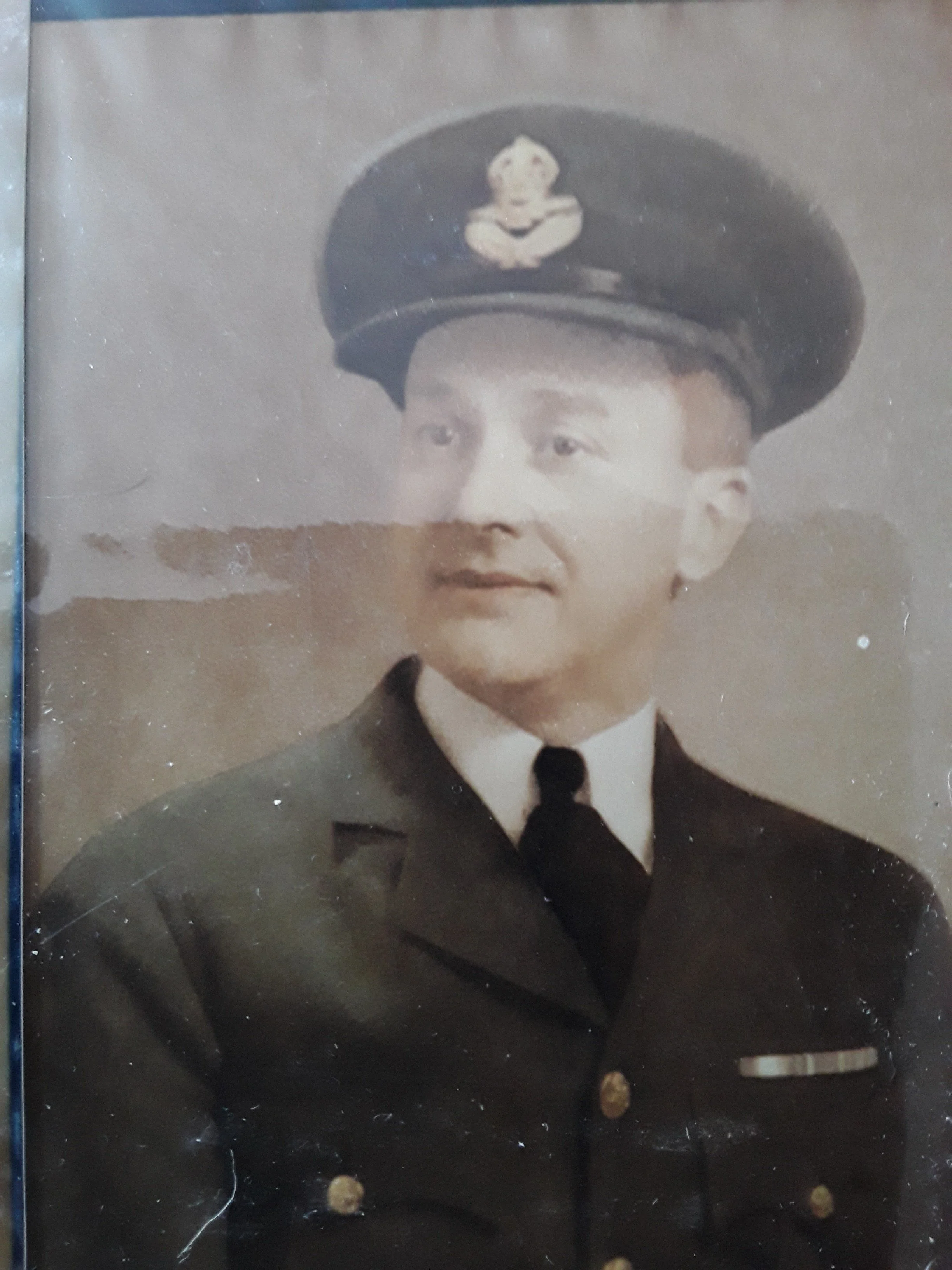
He married Mary Pogue in Toronto on June 24, 1919. They raised four boys, Thomas G. Hills, Ernest J. Hills, Reynold R. Hills, and Donald L. Hills. Ernest continued to work after the start of the Second World War. However, he felt called back to serve and enlisted in the Royal Canadian Air Force. Regimental number C6574, he was an Acting Flight Lieutenant in the Special Reserve Non-Flying Admin and Equipment Branch. He was struck off strength on November 19, 1944, and died from stomach cancer on March 22, 1949. He was awarded the General Service Medal and Canadian Volunteer Service Medal.
We thank him for his service.
We Will Remember Them
NM