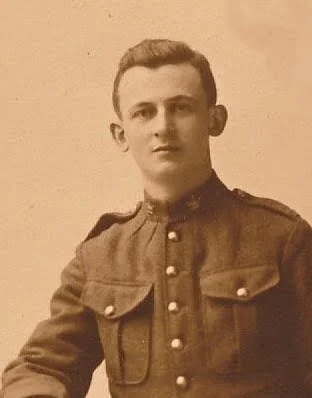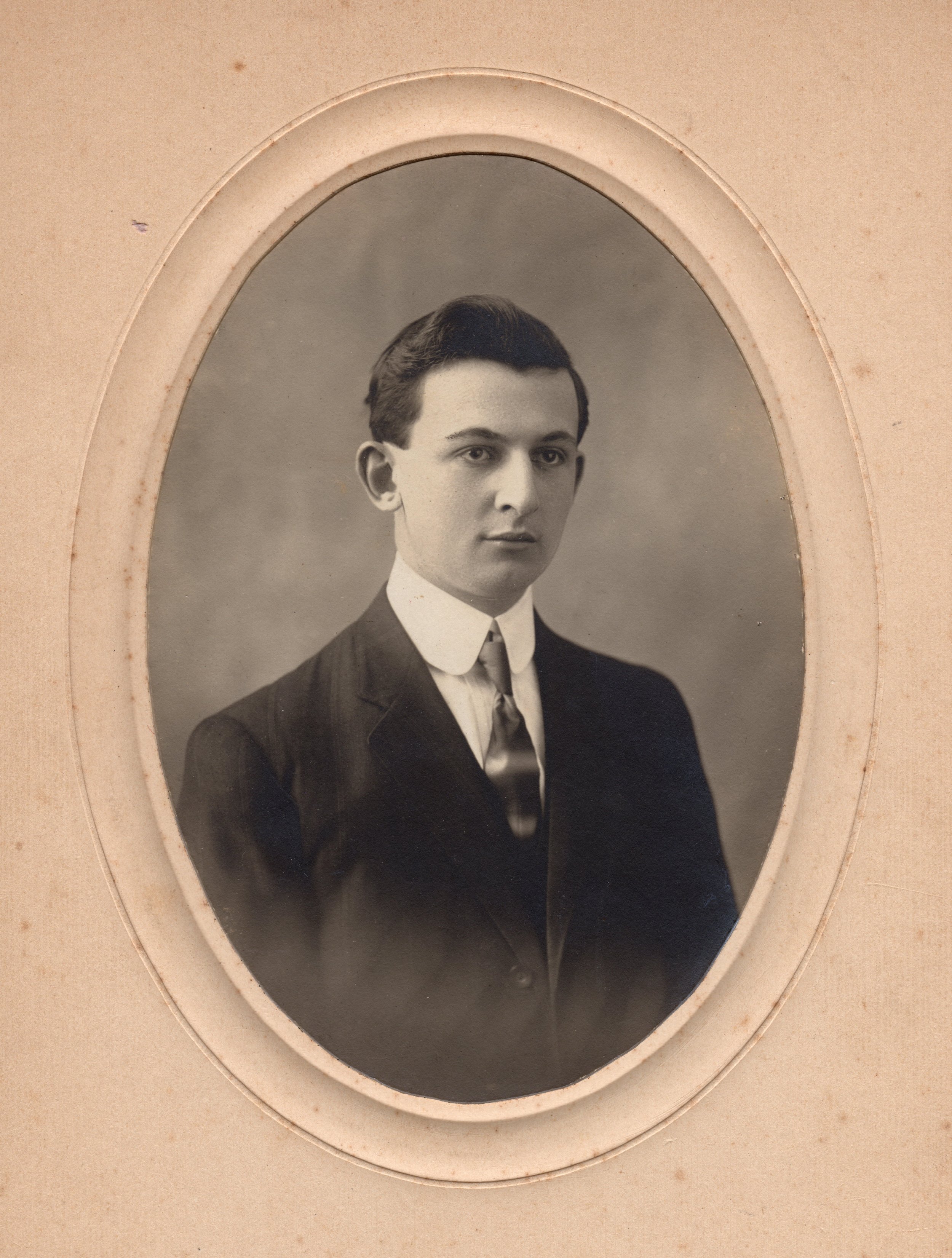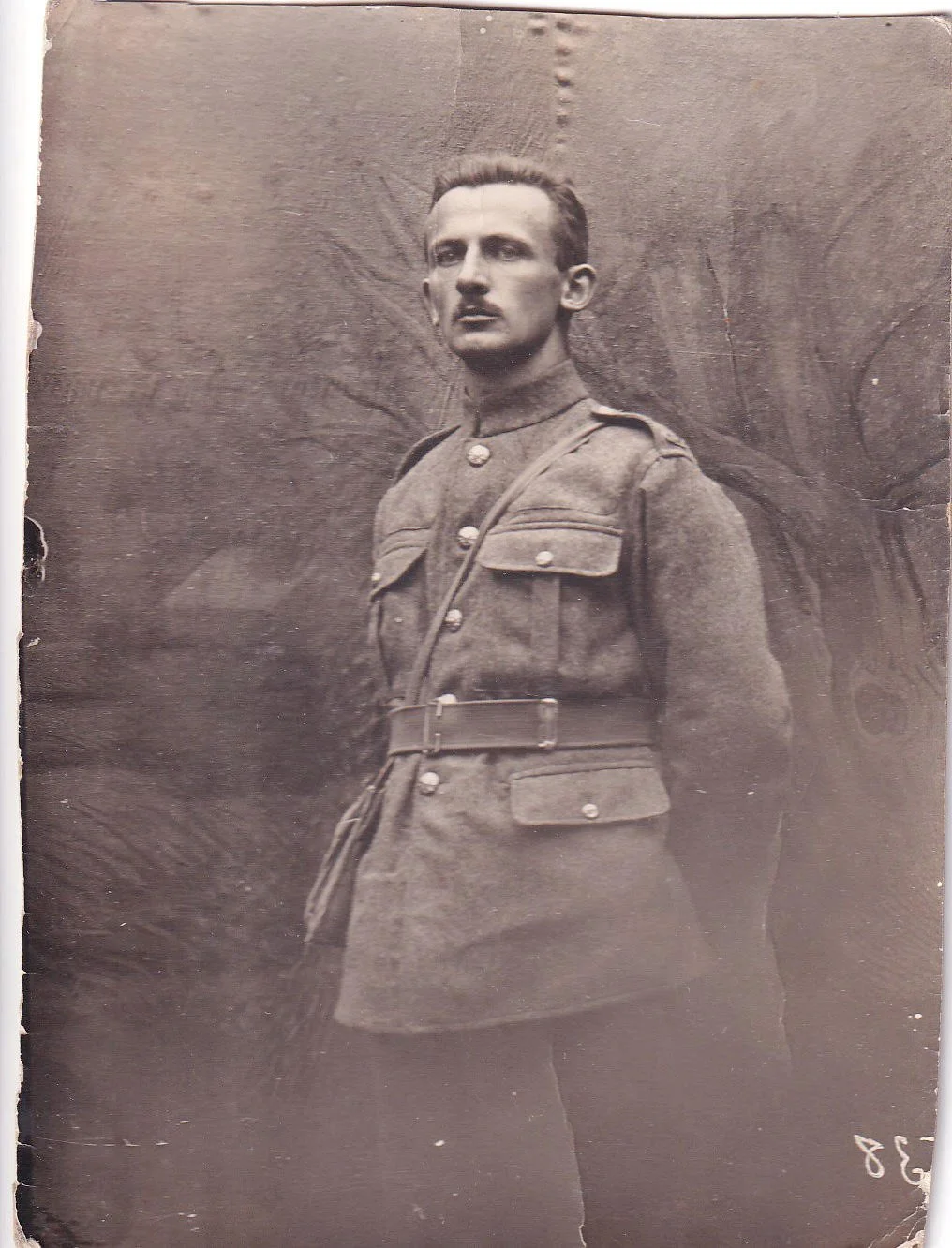

John Earle Lockerby, Private (April 29, 1891 - September 16, 1916)
John Earle Lockerby was a farm boy from Hamilton, Prince Edward Island. The eldest of three sons born to Frederick J. Lockerby and his wife Mary Jane (Minnie) Lockerby, née Ramsay, on April 29, 1891, Earle attended the rural, one-room school at Hamilton, probably taking the first ten grades there. He spent the 1908/1909 school year at a high school in New Glasgow, N.S. where he lived with his uncle, Rev. James Ramsay, who was the Presbyterian minister at New Glasgow from 1907 to 1919. Earle attended Prince of Wales College in Charlottetown during the 1909/1910 session where he was enrolled in the second-year program. In addition to studying English, Latin, Greek, trigonometry, geometry, algebra, chemistry, physics, and botany, he became involved in students’ Christian work.
Next, Lockerby worked two years for the Bank of Nova Scotia. In 1911 he was at the Fredericton, N.B. branch and possibly spent all of his short banking career at this branch. During the summer of 1913 he worked in a student mission field in the Brockway/Tweedside area southwest of Harvey, N.B. Having decided to become a minister, Earle attended Mount Allison University in Sackville, N.B. during the year 1913/1914 and it is recorded that he took English, mathematics, physics and Roman history. During at least part of the term he functioned as an assistant to the Presbyterian minister in Amherst, N.S. During the summer of 1914 he was a student minister in Petries, now a part of Corner Brook in NL. In the fall of 1914 he continued his studies at Dalhousie University in Halifax, N.S. (Class of 1917), intending to obtain a B.A. degree and to then study theology at Pine Hill Divinity Hall in Halifax.
One student at Dalhousie from the Class of 1917 with whom Earle was particularly friendly was Annie Isabella Fraser from Pictou, N.S. She was the youngest daughter of Rev. James William Fraser and Isabella MacKay. One thing they would have shared is the Presbyterian religion and an interest or background relating to its ministry. They may have met at Dalhousie. However, it is possible that they first met when Earle was living with the Rev. James Ramsay at New Glasgow which is not far from Pictou. Rev. Ramsay would certainly have known Rev. Fraser.
On August 4, 1914 Great Britain declared war on Germany. Canada’s connection to the “mother country” was such that this meant that Canada was automatically at war. The Canadian government strongly supported Canada’s involvement, as did most of its citizenry, particularly those of British extraction. Indeed, the outbreak of war triggered a great sense of patriotism and many young men signed up to fight. J. Earle Lockerby enlisted on December 1 in Halifax and in a letter to his father written on the same day he stated that “over half the fellows are going before the spring,” meaning that over half of his male classmates (or perhaps more than half of the male students then attending Dalhousie) would be on their way to Europe before the spring.
In his attestation paper for joining the Canadian Overseas Expeditionary Force, Earle gave his date of birth as April 29, 1892, but from his baptismal record of September 27, 1891 it is clear that his actual date of birth was April 29, 1891, the same year on which Annie Fraser had been born. From military medical records dating from December 1, 1914 we learn that Earle was 5 feet 9 inches in height, had blue-grey eyes and dark brown hair, and weighed 145 pounds.
From the day of enlistment, Earle knew that he would be in a “cycle corps,” as he advised his father in the letter of December 1, 1914, and would carry the rank of private. It is not clear whether December 1 marked Earle’s last day of attendance at Dalhousie or whether he continued his studies there for some weeks. In any event, he remained in the Halifax area for at least a few weeks since on December 19 he arrived in Hamilton, P.E.I. from Halifax to spend a few days with his family. The occasion was utilized by the community for a gathering to honor, thank and congratulate Earle for having “heard the call of our country in this her hour of need,” and for having “done his duty in putting down his name as a volunteer,” an action by which, he was told, he had honoured himself, his family and his community.
Upon Earle’s return to Halifax on December 22 it is likely that he subsequently headed for Toronto where the 2nd Division of the Canadian Cyclist Corps was assembled under the command of Colonel Denison from platoons that came from Halifax (believed to be No. 1 Platoon), Montreal, Toronto, Kingston, Winnipeg and Vancouver. In any event, on June 12, 1915 the Halifax Herald published a photograph of 35 uniformed men, including John Earle Lockerby, referring to them as “No. 1 Platoon Divisional Cyclist Corps, A Splendid Body of Maritime Men.” Drawn from the Maritime Provinces, two-thirds of them were “university men,” including six from Dalhousie University. Three days later, while in Halifax, Earle addressed a postcard to Miss Annie Fraser, Pictou, writing, “Going on board the Caledonia in 10 minutes.” He provided Annie with an address through which he could be reached in England. The S.S. Caledonia, 9,233 gross tons, 500 feet long and built in Glasgow in 1904, was a passenger ship that had been requisitioned by the British government upon the outbreak of the war. In peacetime she carried 1,450 passengers but for war purposes the vessel’s carrying capacity was rated at 3,074 troops and 212 horses. In 1916, the same year that John Earle Lockerby would lose his life in France, the Caledonia would be sent to the bottom of the Mediterranean by a German U-boat.
Earle arrived in England on June 24 after a passage of about nine days and was immediately “taken on strength” at Shorncliffe, a large army camp near Cheriton, Kent on the southeast coast of England, overlooking the English Channel. It had had a long history as an army base, having been established in 1794. Shorncliffe was used as a staging post for troops destined for the Western Front during World War I and in April 1915 a Canadian Training Division was formed there. According to local newspapers, the first Canadians arrived there on April 18 and were a cheerful bunch, naively hoping for a taste of battle before the quick victory they still expected. Quite likely, this is a sentiment that Lockerby would have shared. The camaraderie experienced at Shorncliffe was likely the last real happiness he knew.
Not everything went well for Earle at Shorncliffe, however – problems became apparent very soon after his arrival in England. On July 1 he was admitted to the Moore Barracks, Canadian Hospital, Shorncliffe, suffering from pleurisy. His hospital stay lasted until July 18, at which point, according to his medical record, he had “completely recovered.”
Whatever military training Earle may have received in Canada, he likely received more at Shornecliffe over the ensuing two months. Training would have consisted of the usual courses in musketry, bombing, bayonet fighting and gas, as well as specialized instruction in signaling, range-finding, Lewis Gun, topography and tactics.
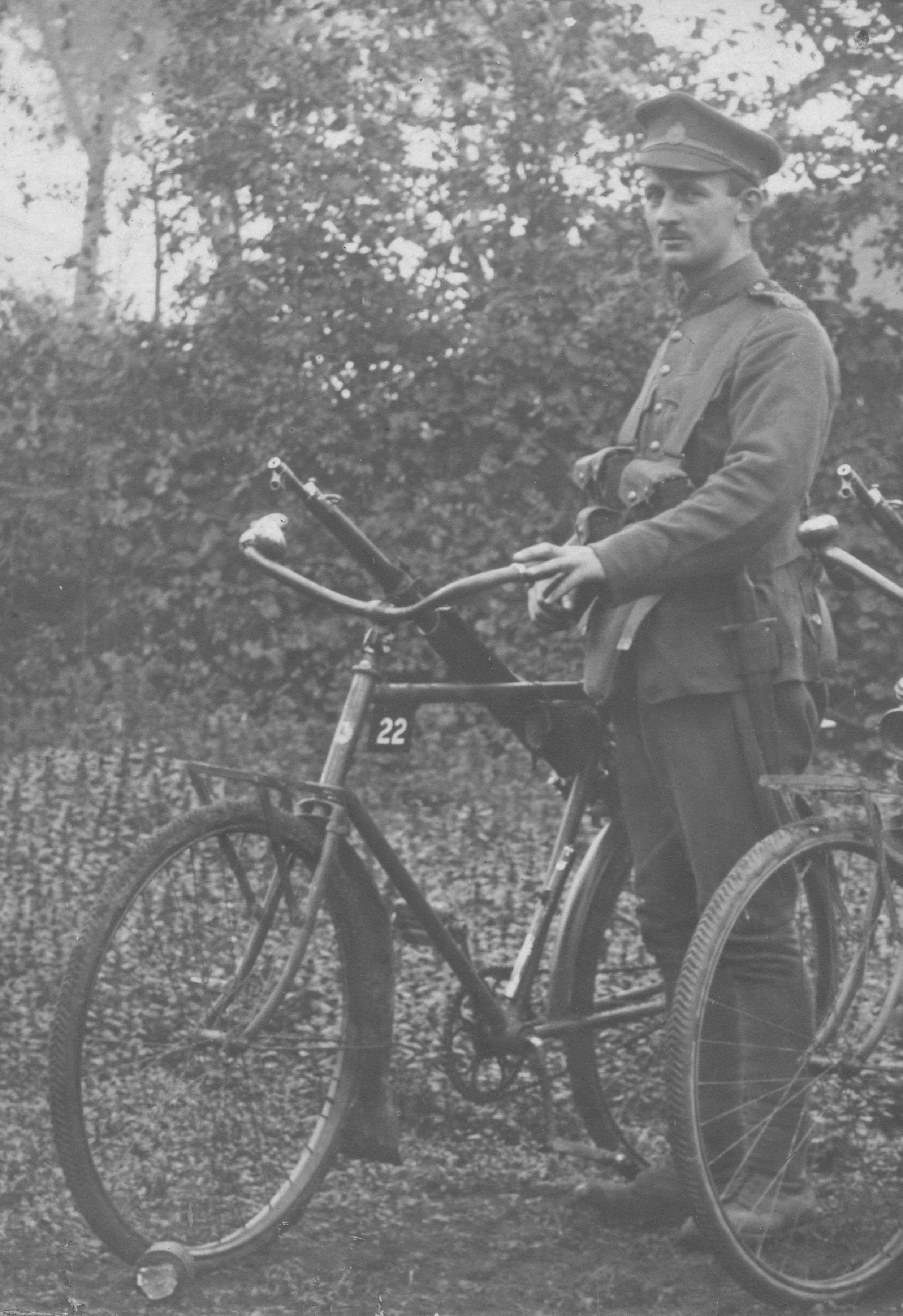
Earle was a member of the Second Division, Cyclist Corps – he and his comrades were bicycle “pedal pushers,” not motorcycle riders. It may seem a little quaint today, but in World War 1 bicycle-mounted infantry, scouts, messengers and ambulance carriers were extensively used by all combatants; indeed, among the Canadian troops were five divisions of cyclist corps. Bicycles were found to be invaluable for reconnaissance and communications work, being lighter, quieter, and logistically much easier to support than horses. To some extent, bicyclists took over the functions of dragoons, substituting for horses in warfare and in the quick transport of men and supplies. Cyclists also acted as battalion runners and dispatchers, as well as soldiers who took part in direct combat.
A photograph that belonged to Annie I. Fraser shows Earle in military uniform, standing beside his bicycle. Attached to the crossbar is a rifle and standing close to him a uniformed Benjamin Chalmers Salter with his similarly-equipped bicycle. Salter was born at Chatham, N.B. and enlisted in Halifax one day after Lockerby enlisted. Salter was a very close friend of Lockerby, and like him, had been studying for the ministry at Dalhousie University. Salter was born in 1892 but because he had not taken time off from university, was several years ahead of Lockerby in his studies to become a minister. He had graduated from Dalhousie in 1913. The military careers of both Lockerby and Salter would closely parallel each other up until the fateful day of September 16, 1916.
On September 15, 1915 Earle and Salter landed in France, soon to see action at the front. While they had arrived together in England, no doubt in high spirits, if not imbued with bravado, there must also have been a sense of nervousness. In a letter referred to in the November 17, 1915 issue of the Dalhousie Gazette, Salter, writing from “somewhere in France,” mentioned the Cyclist Corps and reported that the corps was “not by any means …the suicide club they had all anticipated.” For the most part, a member of the Cyclist Corps would not be as exposed to direct combat as foot infantrymen. For some reason, Earle and Chalmers Salter transferred to a more dangerous role: they transferred to “C” Division of the 42nd Battalion, also known as the Royal Highlanders of Canada, an infantry battalion in the Canadian Expeditionary Force. For Earle the transfer occurred on July 14, 1916.
Our knowledge about which battlefields Earle fought on after arriving in France is fragmentary. A letter to a friend, Miss Florence Hill of Hamilton, P.E.I., dated August 17, 1916, was written in Belgium. Yet, about a month later we know that Earle was definitely engaged in the Battle of the Somme in France, specifically the Battle of Flers-Courcelette.
In his letter of August 17, 1916, the only one of his letters from Europe that is known to have survived, he wrote of a close call that he had recently had – “considerable excitement” as he termed it. “One of ‘Fritz’s’ shells landed in our billet and accounted for fifty seven lads. I lost all my belongings, equipment and everything. It was almost a miracle that I escaped. But except for a shock and being almost blinded by smoke and dust, I was not hurt…Please don’t mention this to anybody [Lockerby’s family lived in Hamilton] as I don’t wish them to know at home.”
John Earle Lockerby’s luck would run out less than a month from the time he wrote his letter to friend, Florence Hill. The battle of Flers-Courcelette began on September 15 and Earle was in the thick of it from the outset. In a letter penned in the following October to the Chatham Red Cross Society, thanking the organization for a comfort package he had received, Chalmers Salter closed by writing: “my mate is missing since the 15th of last month and since there is no further hope for him being alive I shall have to write his mother tonight lest we soon go into the line again.”
A letter written by Chalmers Salter to Earle’s father, after Earle was killed, described events in great detail during the 24 hours or so prior to Earle’s death, beginning with immediately after the mid-day meal on September 15 as Earle and Chalmers were preparing “to attend church.” That intention was suddenly aborted by orders to “go over the line and make an attack at five o’clock that afternoon.” They “fell in at once in battle order,” marching five miles where they succeeded in capturing their objective, advancing a distance of six hundred yards. “Earle and I were among the first to reach the Germans who held up their hands and cried for mercy.”
Having labored all night, both men were dead tired in the morning. “We ate some bread and bully beef then sat down in the trench side by side and slept in spite of cold rain and the continual shower of shrapnel. When at length we awoke pieces of shrapnel lay in the trench all around us. How we lived through that morning is hard to understand.” The two spent some time dreaming about returning to the Maritimes and of the bond that would forever keep them together. They spent much of the afternoon working on the trench. Just before 5 P.M. word came that a few minutes later they were to go over the parapet. When they did that they were met by “a veritable sheet of lead.” After making it about halfway between their trench and that of the Germans, “by common consent we stopped. It was folly to have started that charge. We were so few – just two thinned out companies advancing in daylight against a trench in which the Huns were massed. It would have been madness to have attempted to go further.”
“We lay down in the shell-holes and waited for what might come – a counter-attack, reinforcements from the supports, or darkness. It was here that I saw Earle for the last time. We popped up from our shell-holes together, smiled and waved greetings and dropped as the bullets spat around us.” One of these bullets is believed to have taken the life of John Earle Lockerby.
He may, or may not, have been interred. Certainly, he has no known grave.
An obituary stated that “Lockerby was a man of sterling character. His life was one from which great things were expected. That high sense of duty which characterized his every act led him at last to lay down his life on the altar of freedom.”
Given that Earle has no known grave, his name appears on the magnificent Canadian memorial at Vimy Ridge. His name also may be found on an assortment of war memorials and plaques in the three Maritime Provinces – at Malpeque, P.E.I. on the grounds of the church that he attended as a child and youth; at Veterans’ Memorial Park, Summerside, P.E.I.; at New Glasgow, N.S.; at Mount Allison University; and at Dalhousie University. According to the Dalhousie Gazette of January 15, 1917, “a long list of Dalhousians … fell at Courcelette” – John Earle Lockerby was one of them.
In 1930 Frederick J. Lockerby and his wife, the parents of John Earle Lockerby, created a gift to Princetown United Church at Malpeque, P.E.I, the home church of Earle while he was growing up, in memory of Earle and other sons of the congregation who lost their lives in World War I. The gift was the conversion of the gallery on the second floor of the church to a memorial room suitable for meetings, Sunday School classes, etc. A bronze memorial plaque on the east wall of the Memorial Room bears the inscription , “These rooms were prepared and furnished by F.J. and Mrs. Lockerby in memory of their son, J. Earle Lockerby, student for the Christian ministry, and in honour of all other boys from Princetown congregation who also made the supreme sacrifice in the World War 1914-1918.”
At the end of the war Chalmers Salter, by now a Lieutenant, returned to the Maritimes where he served as a minister at a number of churches and congregations, including Kensington, P.E.I. which is only a few miles from the Princetown Congregation. He served as a chaplain in World War II. In 1953 he received an honourary Doctor of Divinity degree from Mount Allison University.
Annie Isabella Fraser must have been heart-broken to learn of Earle’s death. She never married. She became a school teacher, teaching at Pictou and for many years at Westmont, Quebec. She died in Sackville, N.B. on February 2, 1986 at the home of her niece, Isabel Crawford. One wonders what life had in store for Annie and Earle, had he returned from the war.
Prepared by W. Earle Lockerby
July 2017
We Will Remember Them